Queer Places:
Ritwik's Home, 54 Hans Pl, London SW1X 0LA, UK
39 Upper Grosvenor St, London W1K 2NG, UK
Eton College, Windsor SL4 6DW, United Kingdom
Villa Eilenroc, 460 Avenue L.D. Beaumont (Avenue Mrs Beaumont), 06600 Antibes, France
Cimetière du Grand Jas de Cannes, 2 All. du Cimetière, 06400 Cannes, France
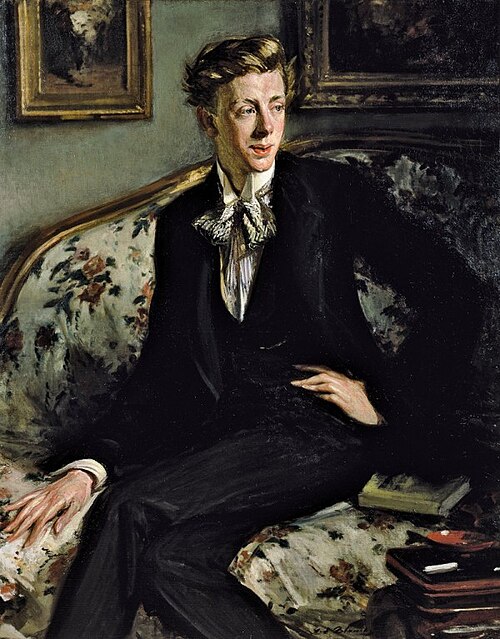 Sir Coleridge Arthur Fitzroy Kennard, 1st Baronet (May 12, 1885 – October 7, 1948), known as "Roy," was born on May 12, 1885, in Belgravia, London, and
led a life defined by wealth, elite social circles, diplomatic service, and literary confidences. He was the only child of Lieutenant Hugh Coleridge
Downing Kennard of the Grenadier Guards and Helen (née Wyllie) Kennard. Tragically, his father passed away in 1886 when Roy was only an infant, and his
mother later remarried the Irish nationalist politician James Laurence Carew in 1896. Through his mother, the family maintained strong artistic and
progressive connections, notably supporting the memory of Oscar Wilde and later helping finance the commission of
Wilde's tomb by Jacob Epstein.
Sir Coleridge Arthur Fitzroy Kennard, 1st Baronet (May 12, 1885 – October 7, 1948), known as "Roy," was born on May 12, 1885, in Belgravia, London, and
led a life defined by wealth, elite social circles, diplomatic service, and literary confidences. He was the only child of Lieutenant Hugh Coleridge
Downing Kennard of the Grenadier Guards and Helen (née Wyllie) Kennard. Tragically, his father passed away in 1886 when Roy was only an infant, and his
mother later remarried the Irish nationalist politician James Laurence Carew in 1896. Through his mother, the family maintained strong artistic and
progressive connections, notably supporting the memory of Oscar Wilde and later helping finance the commission of
Wilde's tomb by Jacob Epstein.
Kennard inherited a massive fortune from his grandfather and namesake, the co-founder of the Evening News and Member of Parliament Coleridge Kennard.
Though the elder Kennard passed away just before his patent was officially gazetted, the baronetcy of Fernhill in the County of Southampton was conferred
upon the young five-year-old Roy in 1891. Educated at Eton College, young Kennard quickly developed into a striking figure. In 1904, the prominent artist
Jacques-Émile Blanche painted a portrait of him at age nineteen, capturing him as an effeminate dandy.
This likeness deeply disturbed his mother—who felt it exposed too much of his true inner self—resulting in a lifelong rift between her and the artist.
The portrait was later exhibited anonymously in 1924 under the title Le portrait de Dorian Gray.
Stepping into elite social and intellectual spheres, Kennard became a prominent fixture of the early twentieth-century avant-garde and LGBTQ-linked
circles. In November 1907, he was among the distinguished guests at a dinner party hosted by Robbie Ross to
celebrate the twenty-first birthday of Vyvyan Holland, the son of Oscar Wilde. Alongside figures such as
Henry James, Ronald Firbank, and
More Adey, Kennard cemented his place in these sophisticated artistic networks, ultimately becoming best
remembered as a loyal supporter and literary confidant to Ronald Firbank. Rumoured to have been bisexual, a status reinforced by homoerotic elements
within his personal verse, Kennard moved effortlessly between conventional high society and bohemian artistic communities.
Following in his father's footsteps, Kennard initially served in the Grenadier Guards before joining the British Diplomatic Service. Between 1908 and
1919, he undertook diplomatic postings across Italy, Persia, Sweden, and Finland. His personal life during this period proved famously tumultuous. While
stationed at the Foreign Office, he became infatuated with the wife of James Frances Buckley, going so far as to threaten suicide if she did not elope
with him, which ultimately led to the Buckleys' divorce. While waiting for the statutory waiting period to expire, Kennard was posted to Tehran, where he
met Dorothy Katherine Barclay, daughter of the British Minister Plenipotentiary Sir George Head Barclay. When Mrs. Buckley traveled to Tehran to claim
him, Kennard refused to see her, prompting Sir George to use his official authority to expel her from the country.
Kennard married Dorothy Katherine Barclay on April 5, 1911, and the couple had two sons: Sir Lawrence Ury Charles Kennard, born in 1912, and Sir
George Arnold Ford Kennard, born in 1915. The marriage dissolved in divorce in 1918. Years later, in July 1924, Kennard married for a second time to
Mary Graham Orr-Lewis, daughter of the Canadian industrialist Sir Frederick Orr-Lewis, 1st Baronet. Mary sadly passed away in 1931.
Decades later, World War II brought severe personal hardship when Kennard was captured and imprisoned by German forces in the concentration camp
established at St. Denis. Following his liberation in 1945, he processed his wartime imprisonment through literature, publishing a collection of doggerel
verse titled Les Complaintes de St. Denis. Kennard passed away on October 7, 1948, at the age of sixty-three in Grasse, France, and was laid to rest at
the Cimetière du Grand Jas in Cannes. The baronetcy initially passed to his eldest son, Lawrence, and upon the subsequent death of his youngest son,
George, without surviving male issue, the Kennard baronetcy became extinct.
References:
- Hansard (UK Parliament) records detailing the legislative history and background of the Kennard family's political footprint, including references to his grandfather, MP Coleridge Kennard.
- Official UK baronetcy registries and historical gazettes regarding the creation of the baronetcy of Fernhill in the County of Southampton (1891).
- Biographies and critical works concerning the novelist Ronald Firbank, for whom Sir Coleridge Kennard served as a primary literary confidant and financial/personal supporter.
- Biographies and collections concerning Robert "Robbie" Ross, tracking elite intellectual circles of the early 20th century, including the 1907 birthday dinner for Vyvyan Holland and the commissioning of Oscar Wilde’s tomb at Père Lachaise Cemetery.
- Documentation concerning the 1904 portrait of Kennard by artist Jacques-Émile Blanche (exhibited anonymously in 1924 as Le portrait de Dorian Gray), detailing the rift it caused with Kennard's mother, Helen.
- Burke's Peerage, Baronetage and Knightage (detailing lineage data for the Kennard baronets, Barclay connections, and the Orr-Lewis family alliances).
- Civil registration, census, and passenger manifest records for birth (Belgravia, 1885), marriages, and death/burial records (Grasse and Cimetière du Grand Jas in Cannes, France, 1948).
- Documentation from World War II regarding British civilian/diplomatic internees held by German authorities at the St. Denis camp, alongside Kennard's own post-war publication of doggerel verse, Les Complaintes de St. Denis (1945).
Support this project
This website is a passion project researched, developed, and funded entirely by me. If you find the content valuable and would like to help support the ongoing research and hosting costs, any contribution is deeply appreciated.
Thank you for keeping this independent resource alive!
My books on Amazon: Elisa Rolle's books
BACK TO HOME PAGE